

Garage door repair without a proper diagnosis often trades one small problem for several bigger ones, since the technician never confirms what actually failed. Homeowners left with an undiagnosed fix frequently end up paying twice: once for the wrong repair, then again for the real one later.
Understanding these consequences helps identify when a repair company took a shortcut that will eventually cost far more than expected. This guide breaks down what tends to go wrong when diagnosis gets bypassed, covering the financial, safety, and warranty risks involved.
Key Takeaways
- Bypassing diagnosis often leads to replacing parts that were never actually broken.
- Undiagnosed repairs frequently fail again within weeks, requiring a second service call.
- Safety risks like sudden door collapse become far more likely without proper testing.
- Manufacturer warranties can be voided when repairs skip documented troubleshooting.
- Avoiding this mistake starts with requesting a written diagnosis before any repair begins.
What Goes Wrong When Diagnosis Gets Skipped?
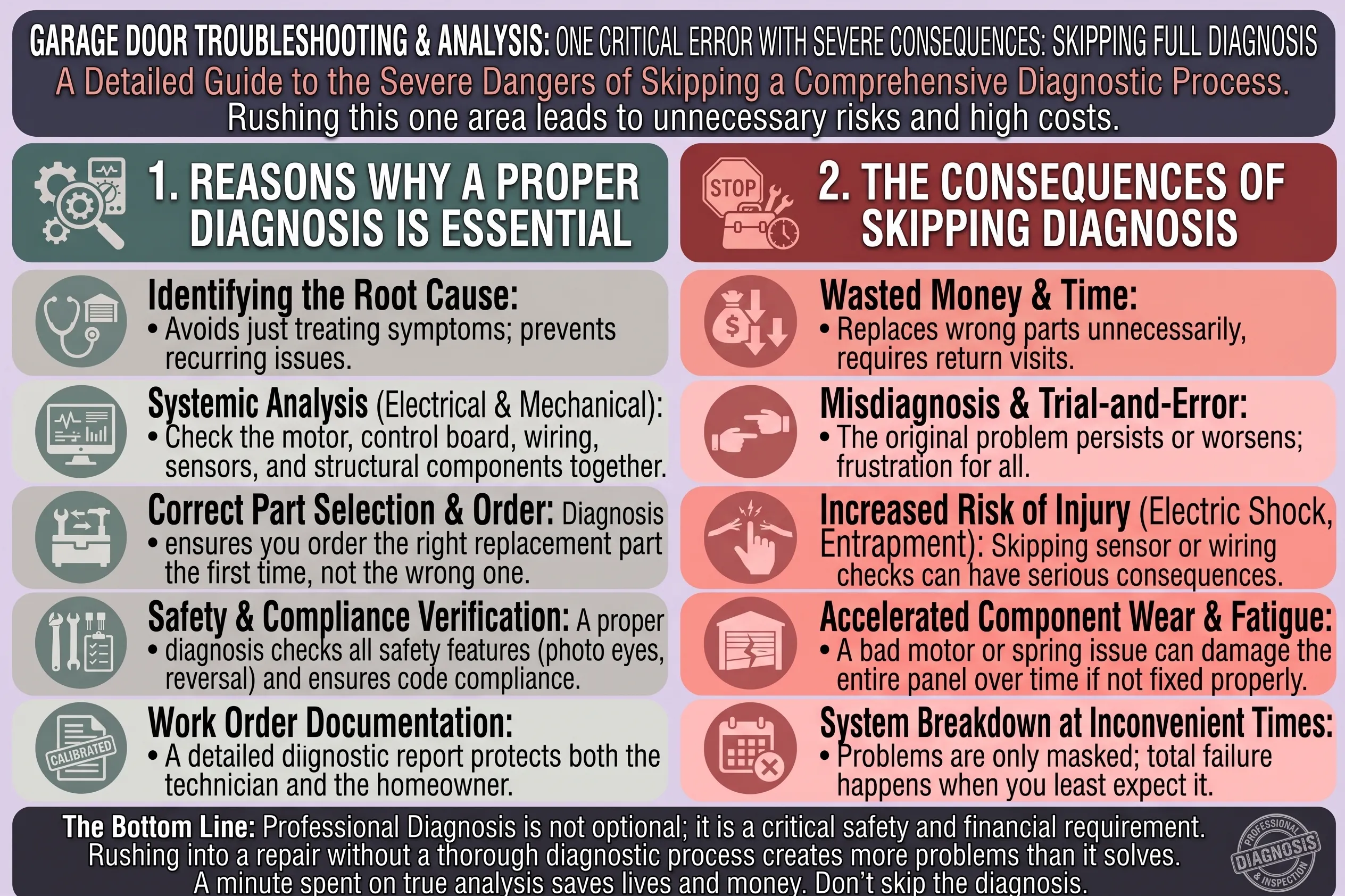
Bypassing diagnosis tends to produce a predictable set of financial, safety, and operational consequences that stack on top of each other.
Consequence | What Happens | Why It Happens |
Wasted Money on Unneeded Parts | A working component gets replaced instead of the actual broken one | No testing confirms which part truly failed |
Repeated Service Fees | The door breaks down again shortly after the first repair | The root cause was never identified or fixed |
Accelerated Wear and Tear | A minor issue puts extra strain on other components | Ignoring small problems lets them compound over time |
Sudden Door Collapse | The door drops unexpectedly without warning | Hidden fractures in springs or cables go undetected |
Failed Safety Reversals | The door fails to stop when something is underneath it | Photo-eye sensors and reversal mechanisms go untested |
Compromised Home Security | The door fails to close or seal properly | An alignment issue goes unnoticed and unresolved |
Voided Manufacturer Warranties | Coverage no longer applies to the repaired component | Warranties often require documented professional troubleshooting |
Chronic Operational Frustration | The door keeps squeaking, reversing, or moving slowly | The underlying mechanical friction was never identified |
Tracing any of these consequences back far enough always leads to the same missing step: confirming the actual cause before recommending a fix.
Financial Consequences
Wasted Money on Unneeded Parts
Garage door installation costs climb fast when a technician swaps an expensive part instead of confirming what actually broke.
These substitutions happen more often than expected:
- Installing a full opener assembly instead of a single failed capacitor.
- Replacing a sensor when misalignment was the actual problem.
- Swapping cables that showed no signs of wear or fraying.
- Charging for a new circuit board when the issue was a simple wiring problem.
- Billing for labor on parts that never left the packaging.
Paying for the wrong part solves nothing and leaves the original garage door problems exactly where they started.
Repeated Service Fees
Doors that break down again within days almost always point back to a diagnosis that missed the actual cause.
The pattern tends to repeat in a familiar sequence:
- The same symptom returns within one to two weeks of the repair.
- A second technician gets called out to look at the same issue.
- The homeowner pays another service call fee for the return visit.
- The second visit reveals a cause the first technician never tested for.
- Frustration builds as the bill climbs without a working door to show for it.
Getting the diagnosis right the first time through proper repair services removes the need for a second call entirely.
Accelerated Wear and Tear
Bent tracks and loose hinges left unaddressed rarely stay a small problem for long, since normal daily use keeps adding pressure to whatever went unresolved.
Ignored issues tend to compound in this order:
- Loose hardware puts uneven pressure on the opener over time.
- Misaligned tracks force the rollers to work harder with each cycle.
- Minor cable fraying spreads faster under continued daily use.
- Small vibrations from an unbalanced door loosen additional components.
- What starts as a quick fix can eventually require a new garage door system.
To trace exactly how a missed diagnosis compounds into a bigger repair bill over time, read our guide on Why Is Diagnosis Needed Before a Garage Door Repair?, which breaks down every stage of that progression.
Safety and Security Risks
Sudden Door Collapse
Understanding the safety-testing steps built into a proper diagnosis shows exactly what gets missed when that step gets bypassed.
Hidden damage tends to reveal itself only under continued use:
- Hairline fractures in torsion springs that worsen with each cycle.
- Frayed cables that hold just enough tension to seem functional.
- Weakened brackets that were never tested under full door weight.
- Worn pulleys that redistribute stress unevenly across the system.
- Sudden drops that happen without any warning.
Doors that collapse without warning almost always trace back to a single component that was never actually tested beforehand.
Failed Safety Reversals
Garage door sensor repair becomes urgent once a technician confirms the reversal mechanism never got tested during the original visit.
Failed reversal tests tend to expose a few specific gaps:
- Photo-eye sensors misaligned by even a fraction of an inch.
- Auto-reverse timing that never gets calibrated after a repair.
- Weight-sensing mechanisms left unchecked after new parts get installed.
- Obstruction detection that fails silently during routine operation.
- Doors that continue closing despite something underneath them.
Confirming this mechanism works correctly protects against one of the most common issues tied to an undiagnosed repair.
Compromised Home Security
Doors that no longer seal against the frame create an opening that often goes unnoticed until it becomes obvious.
Security gaps tend to develop through a specific set of failures:
- Alignment issues that leave a visible gap along one edge.
- Weatherstripping that no longer meets the frame evenly.
- Tracks bent just enough to prevent full closure.
- Hardware loose enough to let the door shift slightly.
- Locking mechanisms no longer engaging as designed.
To understand exactly how a technician confirms these gaps get closed properly, read our guide on How to Confirm a Diagnosis Happened in Garage Door Repair, which walks through the exact verification steps worth requesting.
Operational and Warranty Issues
Warranty and operational problems often surface months after the original repair, once the paperwork is actually checked.
These issues share a common root cause:
- Manufacturers requiring documented troubleshooting before honoring a claim.
- Persistent noise or friction that never gets properly diagnosed.
- Coverage disputes that arise from missing service records.
- Recurring symptoms that point to an unresolved mechanical cause.
Voided Manufacturer Warranties
Comparing a repair invoice against manufacturer requirements reveals whether the documentation on file actually protects the coverage a homeowner is counting on.
Warranty claims tend to fail for a specific set of reasons:
- Missing documentation showing a licensed technician performed the repair.
- No record naming the exact part that failed during service.
- Repairs that skip manufacturer-required troubleshooting steps entirely.
- Paperwork that fails to match the part actually installed.
- Claims filed without proof of a professional inspection.
Coverage that depends on proper documentation disappears the moment that paperwork goes missing for good.
Chronic Operational Frustration
Custom garage doors and standard models alike can develop the same lingering issues when the original repair never addressed the actual cause.
Ongoing frustration tends to show up through a consistent pattern:
- Squeaking that returns within days of a supposedly finished repair.
- Openers that reverse unpredictably during normal operation.
- Doors that move sluggishly despite fresh parts.
- Unusual noises that persist regardless of lubrication or adjustment.
- Friction that keeps building since the source was never identified.
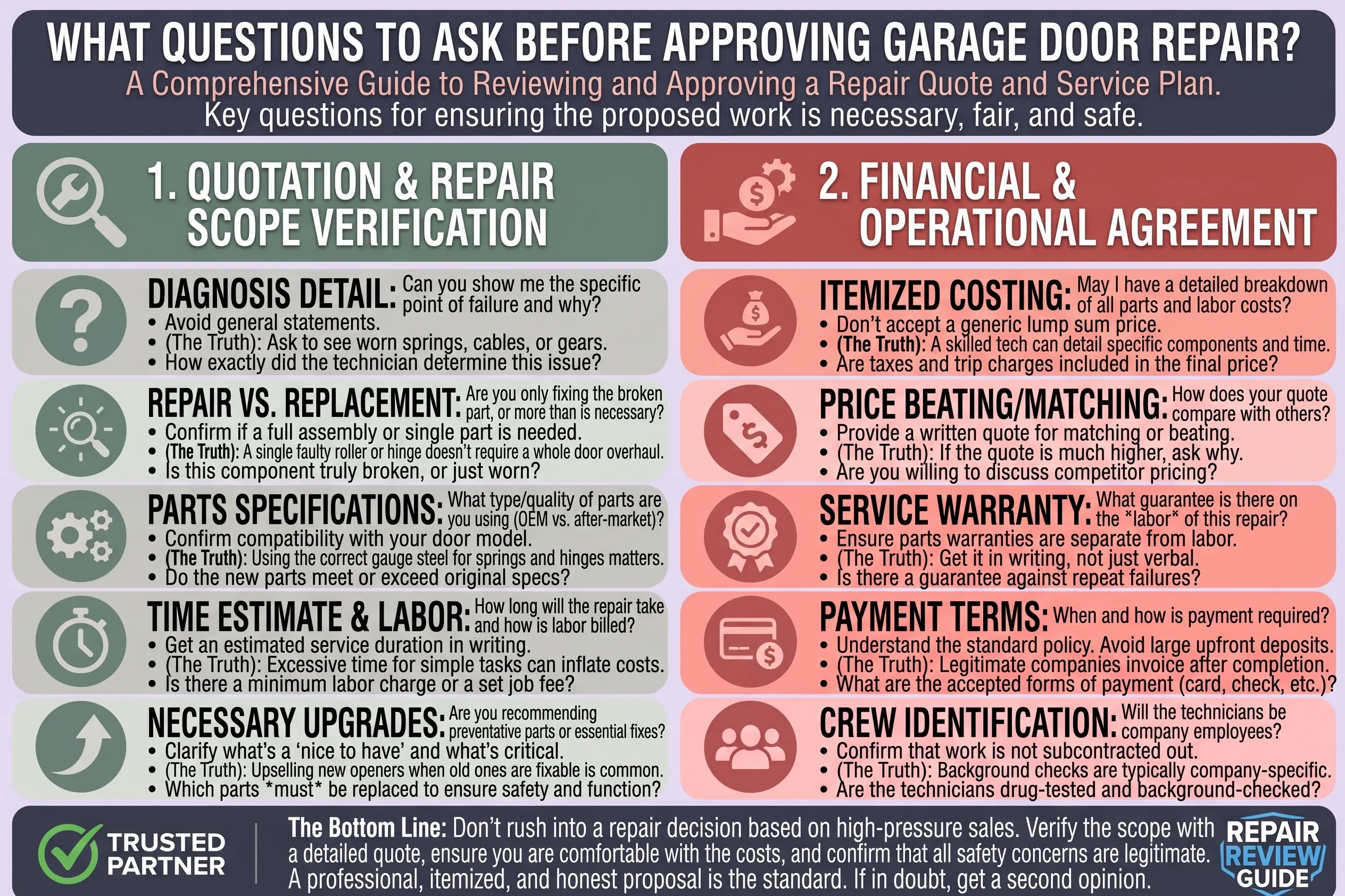
To walk through the exact questions that confirm whether a repair addressed the real cause, read our guide on Questions to Ask Before Approving Garage Door Repair, which covers what to confirm before signing off on any invoice.
What Can Homeowners Do to Avoid the Same Repair Mistake?
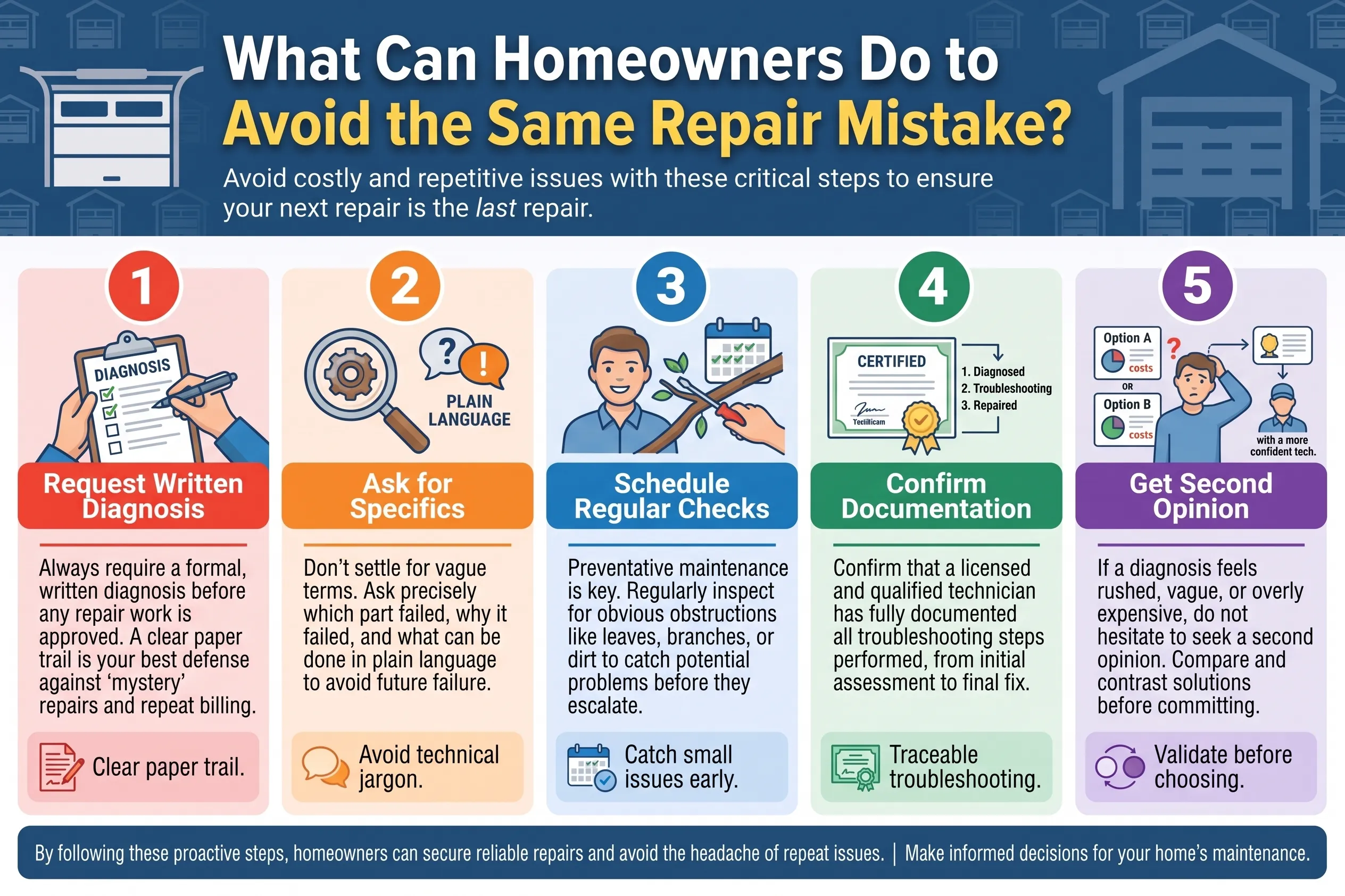
Avoiding a repeat of these consequences starts with treating diagnosis as required, not optional, on every single repair visit.
Several habits protect against this outcome going forward:
- Requesting a written diagnosis before approving any repair work.
- Asking which specific part failed and why, in plain language.
- Scheduling regular maintenance checks to catch obvious obstructions early.
- Confirming a licensed technician documented the troubleshooting performed.
- Getting a second opinion whenever a diagnosis feels rushed or vague.
Treating diagnosis as a non-negotiable first step protects the door’s functionality, the budget, and the safety of everyone who uses it.
Bypassed Diagnosis Turns a Small Repair Into a Bigger Problem
The consequences traced through this guide share the same root cause: a technician who never confirmed what failed before recommending a fix. Closing that gap through proper diagnosis protects against wasted money, safety risks, and warranty disputes that add up quickly over time.
MF Solutions serves Buffalo Grove, IL, homeowners with technicians who document every diagnosis before recommending a garage door replacement or any repair, no matter how small the job seems at first. Contact us or give us a call today, and let our trained team confirm the real cause before any work begins.